Shanghai Express
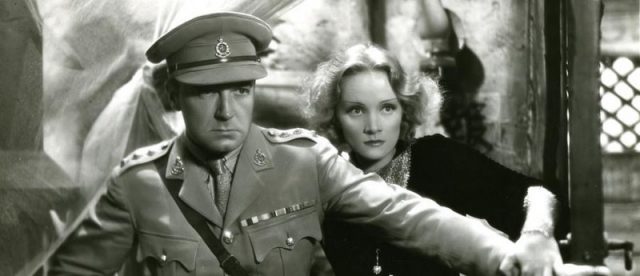
If you like Marlene Dietrich, or rather, love her screen image, you'll love this film. You might find Anna May Wong rather appealing to. Both look glorious in this shiny and busy tale of love and treachery among the chickens, trains, oxen, revolutionaries and coolie hats of the Chinese Civil War.
Oh, and the bell. Don't forget the bell, the one consistent, even insistent continuity in this masterpiece of shifting morals.
Von Sternberg places his camera as close to his principals as he can get while jamming as many other obstacles in his way as he can. The opening scene, where we are introduced to each of the characters that will board the train and become inadvertently involved in a rebel skirmish, shows Peiping (Peking) station rammed with passengers, goods, onlookers, workers, carts almost conspiring to prevent our cast from actually boarding the express. Later, we see the train speeding along (that is, a mock up interior completely stationary in front of a speeding back projection), yet suddenly slowed to a standstill as the railway line appears to be inhabited by a complete market place. The inhabitants on two legs flee swiftly, the four legged stay put. These scenes are handsomely mounted and underscore the chaos and anxiety which threatens to undo our heroes.
And that blasted bell. Just as in American westerns when a train arrives at some lawless outpost with its bell clanging a rhythmic warning of doom, so the express, every time it stops. And it stops much more than it expresses.
Dietrich gleams, stretches, smoulders while her love interest, played by Clive Brook, drawls. He doesn't get to do much else, and (spoiler alert) when finally he kisses her, he has his back to us and we see nothing of it. Not that I particularly want a close-up of an Englishman abroad stiffly mouthing our screen goddess, but it seems to me a signal that theirs is a passionless love and von Sternberg doesn't really have a lot of faith in it.
The most passionate character in the whole affair is the Christian missionary, Mr Carmichael (Lawrence Grant), who spends a lot of angry time in other people's faces. If this had been in Technicolor, his face would have been the ruddiest on the screen. Curiously, everyone else has a rather subdued role. Even the rebel leader (Warner Oland) plays a smooth unruffled Chinese who doesn't even break into a sweat when things aren't going his way.
Lastly, to return to Anna May Wong, her role as Hui Fei, a prostitute with a critical part to play in the plot, seems underwritten. It's not often that a character can commit murder (justified or otherwise) and simply saunter off screen as if she's just been adjusting her hair or making a sandwich.
The film's reputation rests on the Dietrich/Von Sternberg story, and the undoubtedly beautiful cinematography and mise-en-scene, but as stories go, it's a bit thin, and the love affair that is supposedly central to the story is rather stilted and unconvincing.
Oh well, there's always the hairdos to admire. And wonder at the insistence on dividing the frame down the middle, quite ignoring the usual rule about the golden mean.